Security Debugging
This document describes some tools for understanding and debugging Orc8r security. Read the Security Overview first for a top-level understanding of the security architecture.
Architecture
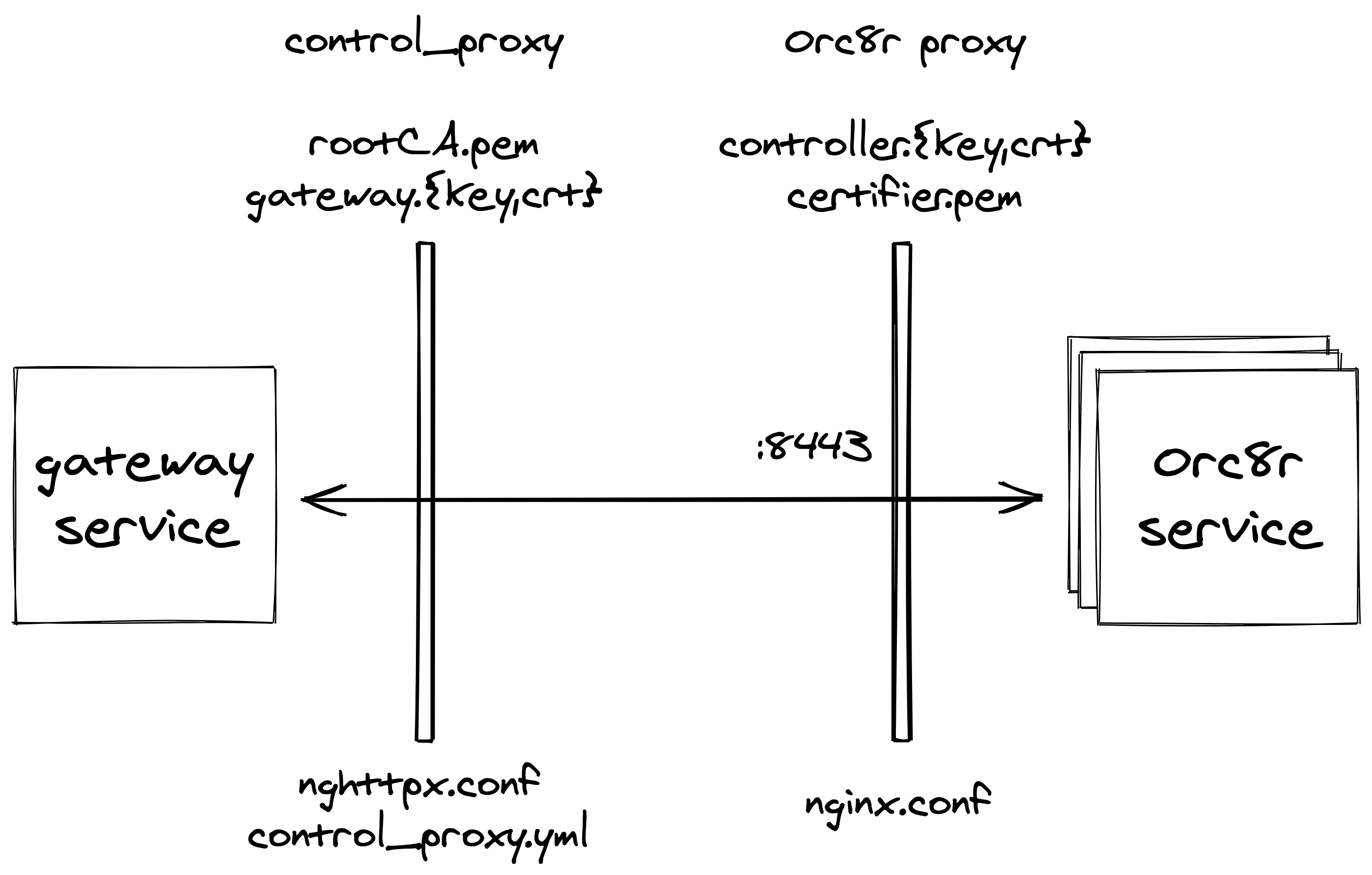
By default, TLS is mutually terminated at the edge of both Orc8r and gateways
- Orc8r terminates at Orc8r proxy
- Server certificate:
controller.crt - Client-validation certificate:
certifier.pem
- Server certificate:
- Gateways terminate at their
control_proxyservice- Server-validation certificate:
rootCA.pem - Client certificate:
gateway.crt
- Server-validation certificate:
In the default configuration, with a registered and fully bootstrapped gateway, TLS termination looks like this
Certificates
Starting point for understanding the set of certificates related to Orc8r
- General
rootCA.pemCA certificate which signedcontroller.crt(root of trust)- When Orc8r self-signs its certificates, the
rootCA.keywill also be included in the deployment
- When Orc8r self-signs its certificates, the
admin_operator.{key.pem,pem}admin operator certificates for full access to Orc8r's northbound interface by NMS and CLIs
- Orc8r
controller.{key,crt}server-validation certificate for Orc8r and NMS, signed byrootCA.pemcertifier.pemOrc8r's client-validation certificate (root of trust)bootstrapper.keyOrc8r's signing key used in the bootstrap processfluentd.{key,pem}Orc8r's certificates for its fluentd endpoints (fluentd is currently outside Orc8r proxy)
- Gateway
gw_challenge.keygateway's long-term key used for the bootstrap processgateway.{key,crt}gateway's session certificates, used as client certificates to Orc8r proxy
There are two roots of trust in Orc8r, as identified above
rootCA.pem- Root of trust for server validation
controller.crt, signed byrootCA.pem, is presented by Orc8r during TLS handshakes
certifier.pem- Root of trust for client validation
gateway.crt, signed bycertifier.pem, is presented by gateways during TLS handshakes
Endpoints
Default Orc8r endpoints, as exposed on Orc8r proxy
:80K8s liveness probe (open):443northbound interface exposing a REST API (mutually-authenticated)- Orc8r proxy exposes this over
:9443, which Helm then maps to:443
- Orc8r proxy exposes this over
:8443general southbound interface (mutually-authenticated):8444bootstrapper southbound interface (server-authenticated)
Gateway bootstrap
The gateway bootstrap process allows registered gateways to securely request signed session certificates from Orc8r, without Orc8r needing to maintain a stateful view of the bootstrap process.
Before the bootstrap process, operators provision a gateway with Orc8r by including the gateway's hardware ID and the public version
of the gateway's gw_challenge.key. Then, during the two-phase bootstrap process, the gateway requests a challenge, signs and returns the
challenge along with a CSR, then receives back signed session certificates.
Get challenge
Performed via the GetChallenge RPC, where a gateway requests a challenge over a server-validated endpoint.
- Define
nonce := randomBytes || timestamp - Define
signature := sign(sha256_digest( randomBytes || timestamp )), computed using Orc8r'sbootstrapper.key - Define
challenge := nonce || signature - Orc8r returns
challengeto gateway
Get signed session certificates
Performed via the RequestSign RPC, where a gateway presents the gateway-signed challenge and a CSR, and receives back the
Orc8r-signed CSR.
- Define
signed_challenge := sign(sha256_digest( challenge )), computed using gateway'sgw_challenge.key - Gateway sends
challenge,signed_challenge, and a CSR - Orc8r validates request
- Validate
challengeby verifying the original embedded signature and the validity window - Validate
singed_challengeby verifying the gateway's signature ofchallenge
- Validate
- Orc8r returns the CSR as the gateway's session certificates, signed by
certifier.pem
Implementation details
Some implementation-specific details, useful for debugging
- Challenge is valid for short period of time (5 minutes)
- Signed CSR includes capped validity duration (4 days)
- Gateways proactively reach out before expiration to re-bootstrap
- Orc8r supports the
echobootstrap mode on a per-gateway basis, where, for testing purposes, gateways simply echo back the challenge to receive session certs - Since Orc8r retains no state across the
GetChallengeandRequestSigncalls, gateways can make multipleRequestSignrequests with the same challenge. This is admissible because session certificates are only granted if the requesting gateway possesses the requisite private key.
Debug tools
This section includes a selection of notes and commands useful for debugging Orc8r from a security perspective.
Notes
- List of additional HTTP/2 debug tools
- Certificate serial number is expected to be unique, but uniqueness is not guaranteed
Gateway information
show_gateway_info.pyshow gateway's hardware ID and (public part of)gw_challenge.keycheckin_cli.pyattempt to check in to Orc8r, outputting debug information on failure
CLI commands
These commands have been useful for debugging Orc8r's northbound and southbound interfaces. These commands are presented targeting a local dev Orc8r spun up by the default docker-compose file, but with minor modifications they can target arbitrary production deployments.
Utilized tools
View certificates and ACLs
# These commands are run from one of Orc8r's application containers/pods

# List all registered operators, along with their ACLs and certificate serial numbers
/var/opt/magma/bin/accessc list

# List all registered certificates, along with their associated identities
/var/opt/magma/bin/accessc list-certs
Debug northbound interface (REST API)
# Make verbose request to REST API ("list networks" endpoint)
curl \
    --insecure \
    --verbose \
    --key ${MAGMA_ROOT}/.cache/test_certs/admin_operator.key.pem \
    --cert ${MAGMA_ROOT}/.cache/test_certs/admin_operator.pem \
    'https://localhost:9443/magma/v1/networks' \
    -H 'accept: application/json'

# Open connection to REST API, logging certificate and handshake info
# See below for some HTTP requests to use once the connection is open
openssl s_client \
    -showcerts \
    -CAfile ${MAGMA_ROOT}/.cache/test_certs/rootCA.pem \
    -key ${MAGMA_ROOT}/.cache/test_certs/admin_operator.key.pem \
    -cert ${MAGMA_ROOT}/.cache/test_certs/admin_operator.pem \
    -connect localhost:9443
Debug southbound interface (gRPC)
# Emulate a full gateway bootstrap
#
# Places generated session secrets at /tmp/magma_protos/gateway.{key,crt}
${MAGMA_ROOT}/orc8r/tools/scripts/bootstrap.bash YOUR_PROVISIONED_GATEWAY_HWID

# You may need to Generate compiled proto definitions (see Miscellaneous
commands)

# Emulate gateway request to bootstrapper service's GetChallenge endpoint (unprotected)
grpcurl \
    -insecure \
    -authority bootstrapper-controller.magma.test \
    -proto /tmp/magma_protos/orc8r/protos/bootstrapper.proto \
    -import-path /tmp/magma_protos/ \
    -d '{"id": "YOUR_PROVISIONED_GATEWAY_HWID"}' \
    localhost:7444 \
    magma.orc8r.Bootstrapper/GetChallenge

# Emulate gateway request to state service's ReportStates endpoint (protected)
#
# gateway.{key,crt} copied from target gateway
grpcurl \
    -insecure \
    -key /tmp/magma_protos/gateway.key \
    -cert /tmp/magma_protos/gateway.crt \
    -authority state-controller.magma.test \
    -protoset /tmp/magma_protos/out.protoset \
    -d '{"states": [{"type": "test"}]}' \
    localhost:7443 \
    magma.orc8r.StateService/ReportStates

# Emulate gateway request to state service's GetStates endpoint (protected)
#
# gateway.{key,crt} copied from target gateway
#
# Note: this is an Orc8r-internal endpoint. To run this outside an Orc8r
# application container, you may have to temporarily mutate some access
# enforcment configuration in your dev setup. Alternatively, you could
# run this command from inside an Orc8r application pod.
grpcurl \
    -insecure \
    -key /tmp/magma_protos/gateway.key \
    -cert /tmp/magma_protos/gateway.crt \
    -authority state-controller.magma.test \
    -protoset /tmp/magma_protos/out.protoset \
    -d '{"networkID": "test"}' \
    localhost:7443 \
    magma.orc8r.StateService/GetStates
Some HTTP requests to use with s_client
GET / HTTP/1.1
Host: localhost:9443

GET /magma/v1/networks HTTP/1.1
Host: localhost:9443
Miscellaneous commands
# Examine a certificate copied to clipboard (macOS)
openssl x509 -text -noout -in <(pbpaste)

# Verify controller's certificate
openssl verify \
    -CAfile ${MAGMA_ROOT}/.cache/test_certs/rootCA.pem \
    ${MAGMA_ROOT}/.cache/test_certs/controller.crt

# Verify gateway's session certificate
openssl verify \
    -CAfile ${MAGMA_ROOT}/.cache/test_certs/certifier.pem \
    gateway.crt  # copied from target gateway

# Consolidate Magma and its imported protos, copying to /tmp/magma_protos/
${MAGMA_ROOT}/orc8r/tools/scripts/consolidate_protos.bash

# Generate compiled proto definitions
cd /tmp/magma_protos/ && \
protoc \
    -I . \
    -I orc8r/protos/prometheus/ \
    --descriptor_set_out out.protoset \
    --include_imports \
    orc8r/cloud/go/services/state/protos/indexer.proto  # or target proto

# Report a real States to State service (this will trigger some indexers)
grpcurl -vv \
    -insecure \
    -key /tmp/magma_protos/gateway.key \
    -cert /tmp/magma_protos/gateway.crt \
    -authority state-controller.magma.test \
    -protoset /tmp/magma_protos/out.protoset \
    -d '{"states": [{"type": "directory_record",
"deviceID": "IMSI001020000000064",
"value":"eyJpZGVudGlmaWVycyI6IHsic2d3X2NfdGVpZCI6ICIxMTY2NDEzNDkwIn0sICJsb2NhdGlvbl9oaXN0b3J5IjogWyJlODhlZThjYy1hYThiLTQxODktOGYxNC00MWQ4M2RlOWNlNGUiXSwgInB5L29iamVjdCI6ICJtYWdtYS5kaXJlY3RvcnlkLnJwY19zZXJ2aWNlci5EaXJlY3RvcnlSZWNvcmQifQ==", "version":"0"}]}' \
    localhost:7443 \
    magma.orc8r.StateService/ReportStates